Campaign Management Positioning Case Studies About Discovery Call →
Meta Ads Agency for Lead Generation · Since 2017 · For companies of 10 to 200 people

Tracked from the ad to the sale, or it is not performance marketing.

I run your Facebook and Instagram campaigns myself, from tracking to reporting, and I report nothing I cannot trace in your CRM to a qualified lead or a closed deal. No junior takes over your account after onboarding. Ad account, pixel and audiences stay in your own Business Manager.

Up to 45 minutes. We qualify fit and I tell you the fastest next step, even if it is not me.

Founder-led delivery
I treat paid social like an engineering problem, not a creative brainstorming session.
64
Clients since 2017
1
Point of contact on every account, no junior
0
Results claimed without tracking to the sale

01   Fit check

If you are deciding who should run your Meta ads, you are in the right place.

Most companies at this point are choosing between an agency, a freelancer and an in-house hire. All three hit the same wall, for the same three reasons, and the next section tells you exactly why. However, there is a fourth option, and it follows a particular order: build the performance marketing system first, then hire the person who runs it. Hiring in-house is the right end state for your company, and the person you hire does much better when three things are already in place on their first day: tracking from the ad to the sale, battle-tested SOPs for creative strategy and testing, and a persona in your customers' own words. I build them, run the account myself, and hand the system to your hire when you hire. In the discovery call we work out which of the three you already have, and which one to build first.

You are a fit if

  • You have been running the ads yourself, in the evenings after the actual business, and you want to hand them to someone you would trust with the budget.
  • You had an agency or a freelancer and at the end could not say which ad brought which revenue.
  • You have posted a performance-marketing role because marketing is supposed to grow now. The posting probably asks for a lot, because the strategy is not settled yet. In the discovery call we work out which part of it brings revenue, and what the person you hire should find in place on day one.
  • You lead marketing, the performance numbers land on your desk, and nobody in the building can judge whether the campaigns bring revenue.

Not for you if

  • You want the cheapest leads without knowing whether they can be closed at all.
  • You do not want tracking to the sale. Without access to your CRM and a sales team that marks leads as qualified or lost, I cannot connect an ad to a sale, and then I will not claim it either.
  • You sell web3, crypto, or fintech.
  • You want a report that looks good. I deliver one that is right.
Book a Discovery Call →

In 45 minutes we find out what your marketing actually needs, and which form fits it.

02   The core problem

Ad budget goes out, performance numbers come back, and nobody in the building can say exactly which ad the sales came from.

I call it performance theater: activity, cheap leads and platform numbers reported as if they were results, so that a retainer or a budget can be justified without anyone having traced a euro to a sale. It needs nobody to blame. It is what the market produces when nobody is responsible for building the tracking from end to end. This problem has four faces, and you probably know at least one of them.

Friday evening, the PDF

You open the monthly report already braced for it to not add up. It does not add up. Under the chart it says next month will be better. It almost never is.

Activity as results

A thousand changes, a fresh batch of creatives, "we restructured the account". All of it is execution. None of it strengthens a performance lever that affects your sales.

The senior in the pitch, the junior on your account

The person you signed with disappears after onboarding. From then on a junior runs your budget, alongside fourteen other accounts.

"Give it a few more weeks"

Meta genuinely needs about six weeks of conversion data. The difference is what happens in those weeks: either tests are run, documented and tracked for their effect on sales, or everyone waits for the algorithm to supposedly finish optimising.

Why the theater survives

The gap between the dashboard and the sale is convenient for everyone. The agency can blame the sales team, the sales team can blame the leads, the platform can be blamed for its attribution. Whoever builds the tracking that closes the gap takes the scapegoat away from all of them. That is why it so rarely gets built.

You did not, however, choose badly. Agency, freelancer or hire, all three run into the same three gaps. The tracking stops at the ad platform, so nobody sees which ad sold. The tests swap the picture or the hook but keep the story, and they run without a hypothesis, by arbitrary rules. And the ads explain the problem in the company's words, because nobody has asked the customers how they describe the problem themselves. Agencies and freelancers work on thin margins and have no time to build all of that, and someone you hire in-house starts with none of it in place and has to build it alone while the budget runs. How I close the three gaps is the next section.

03   Track. Test. Listen.

Three steps, in this order. The first one shows you which ad brought which sale.

You do not have to be a media buyer yourself to understand any of them. Step I makes step II readable, and step III gives step II something worth testing.

  1. I

    Track.

    Every lead and every deal in your CRM carries the campaign, ad set and ad it came from. I track deals, not leads, so a cheap lead that never buys shows up as what it is, and that is the signal to turn the ad off. Before that tracking exists I claim no performance, and I keep pressing on it, even when it is inconvenient in the first month of working together.

  2. II

    Test.

    A concept puts three things together: a persona, meaning one segment of your customers; an offer; and a messaging angle taken from that persona, meaning one reason these people buy. For each concept I write the creative strategy and produce it in several clearly different formats, for example a customer testimonial, someone from your team speaking to camera, or a short demo. The formats run side by side, against each other and against other angles, and every one is measured against the sales in your CRM. An angle that sells can be scaled to a new persona, or I pick a new angle from the same persona to reach another part of your market. How many concepts run at once depends on your budget and your capacity to produce content. In the test log you see which angle, which format and which persona worked and which did not, and once a month I name the current bottleneck, on the call or in a short video.

  3. III

    Listen.

    The persona in step II comes from your customers' own words: sales-call recordings, interviews, reviews and comments, one persona per customer segment. It decides which angles are worth testing, and it gives the ads the words your customers use. Hardly any teams focus on this step, and in my experience it is the step that moves the numbers most. Done in full, it is the No Guesswork Growth Protocol.

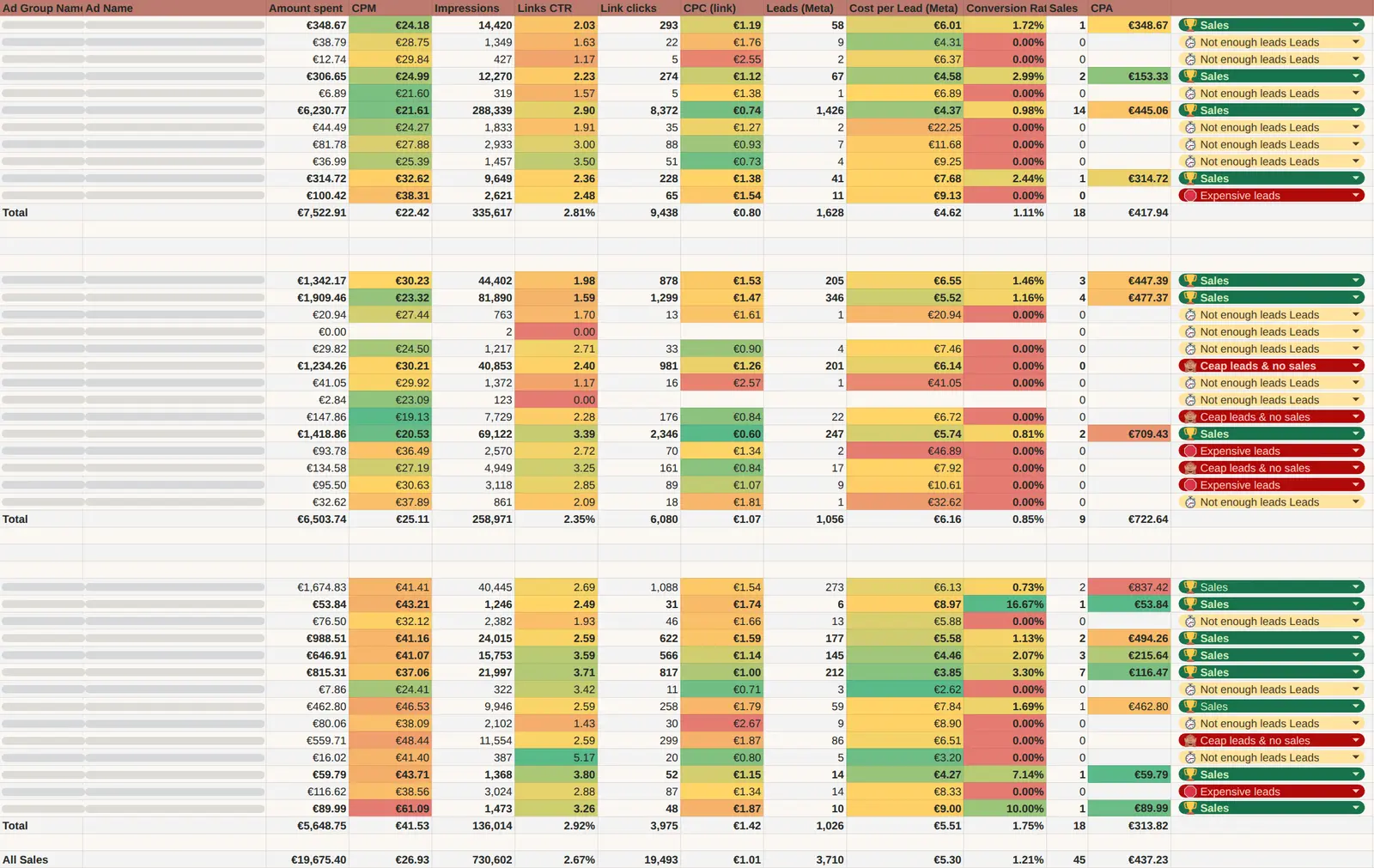
Per-ad report from Iris Arimond's October 2025 launch, ad names hidden
Why step I comes first, from Iris Arimond's launch in October 2025: Meta counted 3,710 leads and her CRM counted 1,763. By Meta's numbers it was the second cheapest of her six launches per lead, at €5.30. By her CRM it was the most expensive per lead and per sale. One ad brought 201 leads at about €6 each and sold nothing, while the same ad sold in another audience. Meta's report alone could not show that difference.

How you can check it

  • Inspectable. A dashboard that refreshes daily, with the KPIs explained, and a monthly video show the work as it happens. Whoever owns marketing can pass that upward without having to translate it.
  • Yours. Ad account, pixel and audiences live in your Business Manager. If you fire me tomorrow, you hand the access to the next person and nothing stops.
  • A senior who stays. On Meta, that is me. There is no account manager whose job is the relationship. There is one name, and that name explains its own decisions.

What I do not promise: a result in the first month, and any number I cannot trace to the sale. That is not caution. It is the difference between performance marketing and performance theater.

04   Two ways to work together

Two ways to work together. Which one fits, we settle in the discovery call.

01

Paid Social Ad Lab: campaign management

I take over your Meta account and run steps I and II, tracking to the sale and tests you can read, in three tiers depending on what you supply and what I am supposed to. Three-month minimum, because we need about six weeks of data from Meta before we optimise instead of guessing. After that, you can cancel with one month's written notice.

When you hire someone in-house, I hand them the tracking, the testing method and the SOPs, and I sit in on your technical interviews of the candidates.

Further channels, YouTube Ads and Google Search, can be added on request, run by a named senior under me.

02

No Guesswork Growth Protocol: positioning and digital sales strategy

Before the first euro runs, we check the message against your real customers: interviews, a buyer persona in their own words, a messaging matrix, a digital sales strategy. Twelve weeks, fixed scope. For your first marketing hires, or for a company where nobody yet knows which message actually sells. I offer it to everyone. It is not a prerequisite.

Read about positioning →

05   How I earn trust

Trust should not require belief. It should require evidence.

I show you what happens behind the scenes, and what you will hold in your hands at the end.

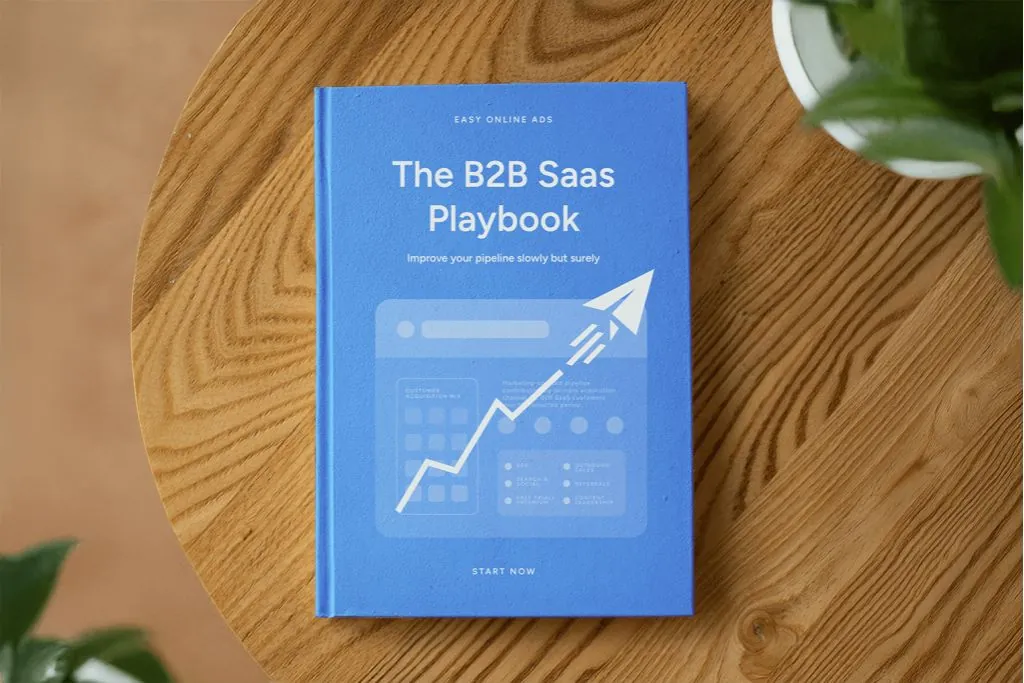
Playbooks and workshop materials

No black box. I show what I do and how.

  • You see the test log, the dashboard and the monthly video from week one.
  • Every decision on the account has a reason, and the reason is written next to it.
  • Playbooks that make the system repeatable.
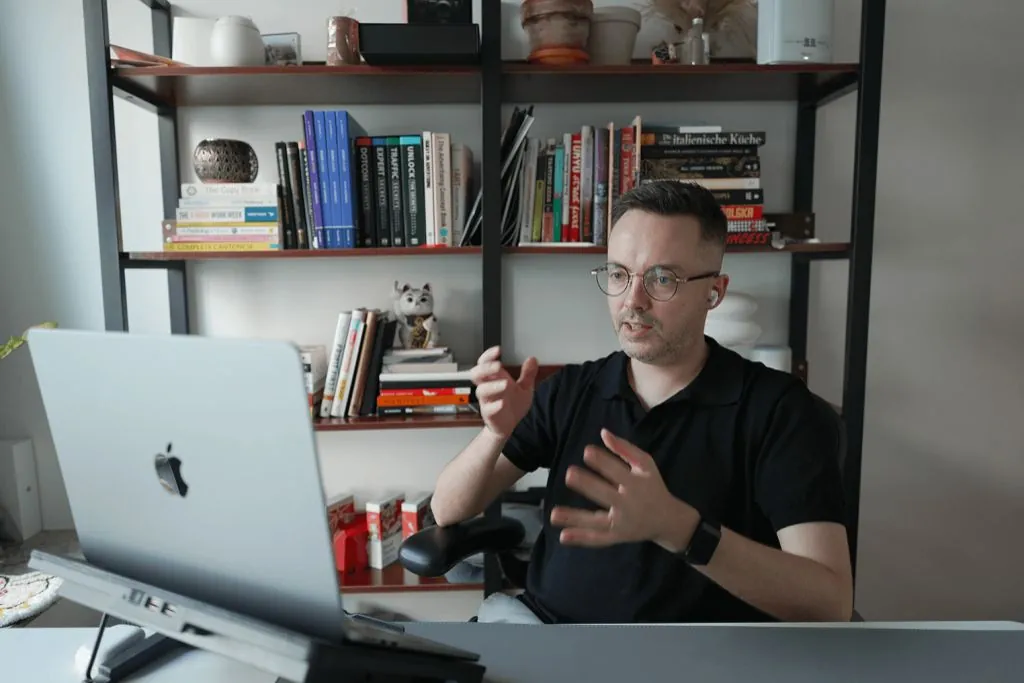
Robert working with a client

One name, not a team.

  • I run every account myself. Since 2017 that has been 64 clients, and on none of them has a junior run the campaigns.
  • I answer an email within one business day. Genuine emergencies have their own line.
  • You always know who is doing what, and why.
Case study deck and dashboards

Case studies with the real numbers.

  • Four case studies from e-commerce, consulting and coaching, each with the metric that was actually measured there.
  • At bellicon that was cost per order, not ROAS, because the reports at the time contained no revenue. So no ROAS is shown there either.
  • Andrea Randt states her numbers herself, in her video. That is why you read her quote there, not my arithmetic.
Robert Zach, founder of Easy Online Ads

07   Who does the work

You work with Robert Zach. Not an account team.

In 2016 I was the in-house marketer at bellicon, an e-commerce company. Facebook ads were new, I ran them, and they won new customers. The partner agency did not look at the numbers, it argued them away: the retargeting buyers would have bought anyway, and Google brand search delivered a far cheaper click. Without tracking to the order the argument could not be settled, so it carried on about the price of a click.

In 2017 I went independent, and bellicon became my first client. We then built exactly that tracking with other clients. Since then every account I run has had one rule: I do not report a revenue number that would not survive that argument. And yes, for a while I was part of the theater myself. How is on the About page.

Robert

08   What this requires from you

Performance marketing only works if you want the tracking, even when the numbers are uncomfortable.

I can measure to the sale if I am allowed to see to the sale. In practice that means:

Access and data

  • Access to the ad account and the CRM on day one, and a sales team that follows a script and marks leads as qualified or lost, plus cooperation when technical measures need implementing.
  • Approvals for ads and assets within three business days. In return, approved ads are live within three business days.

Time and decisions

  • One strategy call a month and one update video a month. It does not take more of your time than that to see what is happening.
  • A three-month minimum on campaign management, for the two reasons above: we need the data from Meta, and you need predictability and stability.

What I do not do

  • I do not optimise for the price of a click. Platform numbers are interim readings to me, not results, and nobody who means it honestly will promise you a record month in month one.
Book a Discovery Call →

I tell you upfront what is missing, so you do not pay to learn it later.

09   FAQ

The questions you ask before you risk another quarter.

Short answers. If you want nuance, bring the messy details to the call.

Will you hand my account to a junior after onboarding?

No, I do not have one. On Meta I do the work myself; on further channels, a named senior under me. You know the name before you sign, and the name stays.

I cannot judge media buying. How do I know you are any good?

I explain the performance numbers without jargon. The dashboard, the test log and the monthly video show what I did, why, and what it did to the sales. And there is one thing you can judge without any expertise: whether someone can explain their own decisions.

Why a three-month minimum?

Because we need roughly six weeks of conversion data from Meta before we optimise instead of guessing, and because I need some predictability myself to hold a high standard. The difference from "the algorithm needs a little more time" is what happens in those weeks: I use them to test, and I document in the test log what is being tested and to what end. You can read that on any day.

Who owns the ad account?

You do. Account, pixel and audiences sit in your Business Manager from day one. If you cancel, you hand over the access and the next person carries on the same day.

Do I have to do the No Guesswork Growth Protocol before you run ads?

No. Without the No Guesswork Growth Protocol you supply the positioning of the message and the creative, and I build the tracking, the testing and the creative strategy around them. The No Guesswork Growth Protocol makes the whole thing complete, because the ad messages have then been checked against real customers before you spend a cent of ad budget. I offer it to everyone; it is not a prerequisite. Once you know which digital sales strategy, which offer and which customer segment converts through Meta ads, I help you implement it and build the operational processes to scale it stably.

We actually wanted to hire an employee.

You still can, and you are right to want someone permanent. Ask your best candidate three questions. How would you track a lead from our ad to the signed deal? How many formats would you test per angle, and how would you read the result? Where would the words in our ads come from? If they answer all three well, hire them, and you do not need me. If not, I build those three now, sit in on your technical interviews and hand the system to the person you hire. They start with tracking that shows you in the first month whether they are good.

What do you not do?

Graphic design and video editing outside the Ad Lab bundle, social media management, organic content and SEO. For those I refer you to people who do them well.

Book a Discovery Call →

Ask the hard questions. You will get clear answers, without jargon.

10   Two paths forward

If you want to know whether this fits, the call is the fastest way to find out.

Up to 45 minutes. I ask you the questions no agency website answers: what your marketing actually needs, what is measured today, and what "success" would mean for you. You leave with a clearer brief, even if you then hire someone else.